Inventing A Supercar
At Davison, we believe true innovation is driven by bold ideas, disciplined creativity, and cutting-edge engineering. Few industries embody this philosophy better than the automotive world of product and supercars. These extraordinary machines are not just vehicles, they are rolling laboratories where advanced technology, futuristic design, and high-performance systems converge to redefine what is possible.
Today’s next-generation supercars are no longer measured solely by top speed or horsepower. They represent a complete ecosystem of innovation, where aerodynamics, materials science, electronics, software, and sustainability all work in harmony. In many ways, supercars show us what happens when imagination is allowed to run at full throttle, and when engineering is trusted to bring it safely back to earth.
Click here to expand the features of the supercar below.
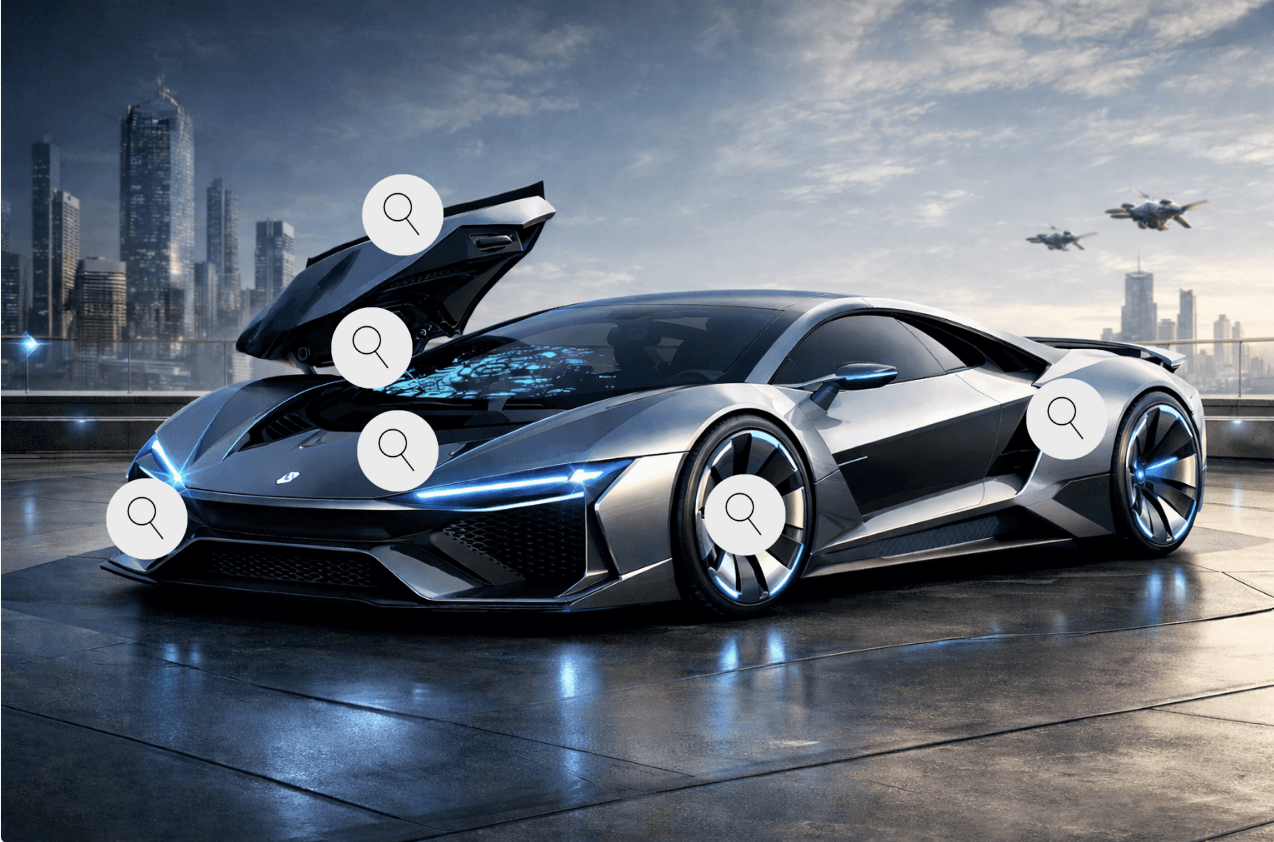
Where Product Design Meets Engineering
Inventing begins with a problem. Inventing a supercars begins with a design challenge.
Supercar engineers and designers must work together from the earliest sketches to ensure that visual impact never comes at the expense of performance. Modern supercars are crafted with aerodynamic precision, where every curve, vent, and surface is intentional.
Airflow is treated as a structural component. Front splitters guide air beneath the chassis to increase downforce. Sculpted side intakes feed cooling systems while reducing turbulence. Rear diffusers and active spoilers manage airflow at high speeds to keep the car planted on the road.
What makes today’s designs especially impressive is the rise of active aerodynamic systems. These systems can adapt in real time,opening, closing, or repositioning elements based on speed, braking, and cornering forces. The result is a vehicle that dynamically reshapes itself for optimal efficiency and stability, something that would have sounded like science fiction just a few decades ago.
Lightweight materials play an equally critical role. Carbon fiber composites, aluminum alloys, and advanced structural plastics reduce mass while increasing rigidity. Less weight means faster acceleration, more responsive handling, shorter braking distances, and improved energy efficiency. It also enhances safety, as modern materials can be engineered to absorb and redirect impact forces more effectively than traditional steel.
Electric Turbo Power: Instant Performance
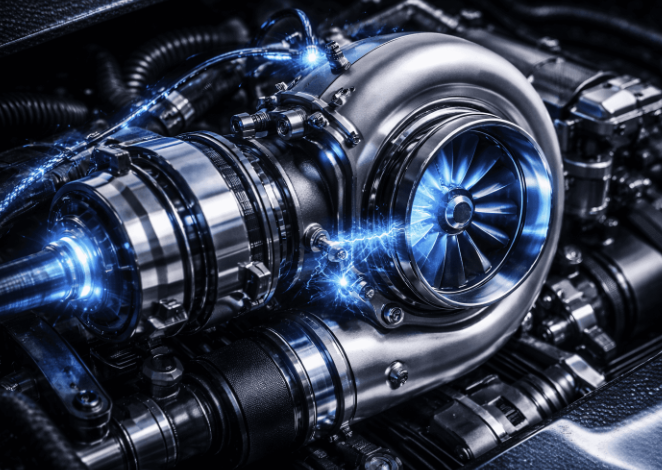
One of the most transformative innovations in modern supercars is the use of electric-assisted turbocharging. Traditional turbochargers depend on exhaust gases to build pressure, which often results in turbo lag, a noticeable delay between pressing the accelerator and feeling the power.
Electric turbo systems eliminate this delay by using an electric motor to spin the turbocharger instantly. Power delivery becomes immediate and linear, creating a smoother and more controlled driving experience. This technology allows smaller engines to produce astonishing levels of power while improving fuel efficiency and reducing emissions.
From an innovation standpoint, this is a powerful lesson: limitations are often solved not by scaling bigger, but by thinking smarter. Electric turbo systems show how combining mechanical engineering with electrical innovation can unlock performance gains that once seemed impossible.
Smart Wheels and Intelligent Control
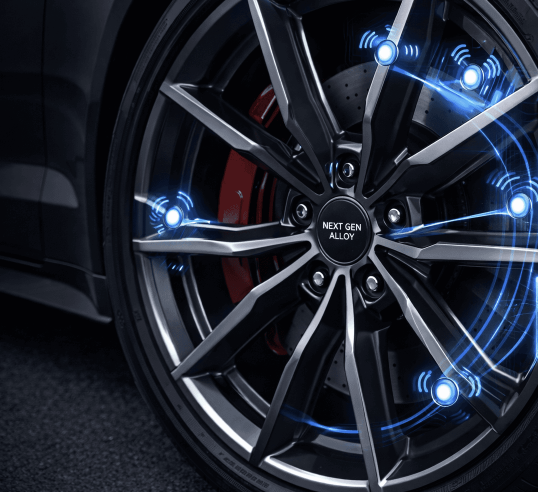
Innovation in supercars doesn’t stop at the engine, it extends all the way to the wheels. Smart wheel and tire systems continuously monitor temperature, pressure, traction, and road conditions. This data is fed into onboard control systems that adjust suspension, braking, and power delivery in real time.
In electric and hybrid supercars, independent motors can control each wheel separately. This enables torque vectoring, delivering power exactly where it’s needed for maximum grip and cornering precision. The result is a vehicle that feels almost predictive, responding to road conditions faster than any human driver could.
These systems are not just about speed. They dramatically improve safety, stability, and adaptability, especially in changing weather or road conditions. Once again, performance innovation proves to be inseparable from user experience and protection.
Augmented Reality Inside the Cockpit
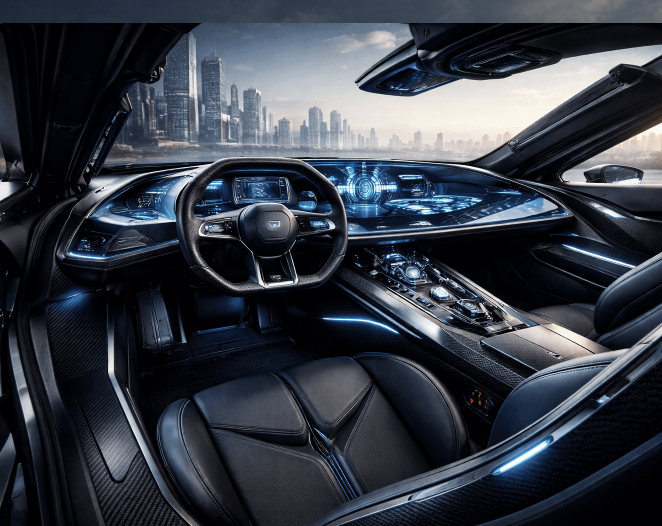
Inside the cabin, innovation becomes personal. Augmented reality (AR) dashboards and heads-up displays are redefining how drivers interact with their vehicles. Instead of glancing down at gauges or screens, critical information,speed, navigation, hazard alerts, and performance data ,is projected directly onto the windshield.
By keeping the driver’s eyes on the road, AR systems reduce distraction and improve reaction times. They also create a more immersive experience, blending digital intelligence with physical motion. This is a clear example of how software and interface design have become just as important as mechanical components in modern product development.
For inventors, it highlights a key insight: innovation often lives at the intersection of disciplines. The most powerful ideas frequently emerge when hardware, software, and user behavior are designed together.
Gullwing Doors & Structural Innovation
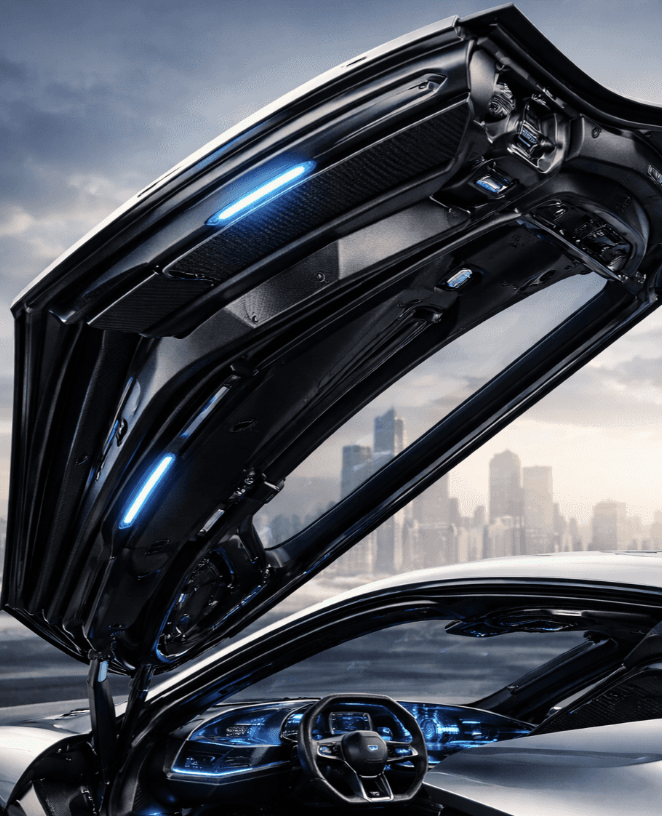
Iconic show-stopping features like gullwing doors are more than visual statements, they are engineering challenges that when solved create a better customer experience. Roof-hinged doors require reinforced frames, precision hinge systems, and lightweight materials to maintain structural integrity and safety.
Modern supercars solve this through advanced load-bearing structures, carbon fiber monocoques, and carefully distributed reinforcement points. The result is dramatic access and unmistakable style without compromising crash protection or rigidity.
This balance between aesthetics and engineering serves as a reminder that great design is never superficial. When executed correctly, even the most eye-catching features are grounded in serious problem-solving.
What Supercars Teach Us About Innovation
Supercars often act as proving grounds for technologies that eventually reach everyday vehicles. Adaptive lighting systems, regenerative braking, advanced driver assistance, lightweight materials, and intelligent energy management all made their debut in high-performance or concept vehicles.
Breakthrough ideas often begin as ambitious, unconventional concepts. With an experienced team, equipped with the right tools, facilities, and engineering capabilities – those ideas can undergo proper testing, detailed refinement, and technical development. The ability to transform an idea into a practical, scalable product solution that impacts everyday life is both rare and deeply rewarding.
The process is rarely linear. It requires creativity, resilience, and a willingness to challenge assumptions. Supercars remind us that progress favors those who are willing to push boundaries,and then put in the work to make bold ideas functional and reliable.
Innovation Starts With an Idea
Those who see problems differently and imagine better solutions use Davison’s proven 9-step inventing method. Whether the innovation is automotive, kitchen, pet, consumer-focused, or rooted in emerging technology, every breakthrough starts with an idea and the determination to bring it to life.
Supercars show us what’s possible when creativity meets engineering, when design is backed by discipline, when innovation is allowed to evolve and dreamers dream without limits. The next groundbreaking technology may not be on the road yet, but it could already exist in the mind of an inventor ready to take the first step – and that’s where innovation truly begins!